
HEVC vs. H.264: Choosing the Best Codec for High-Quality TikTok Downloads
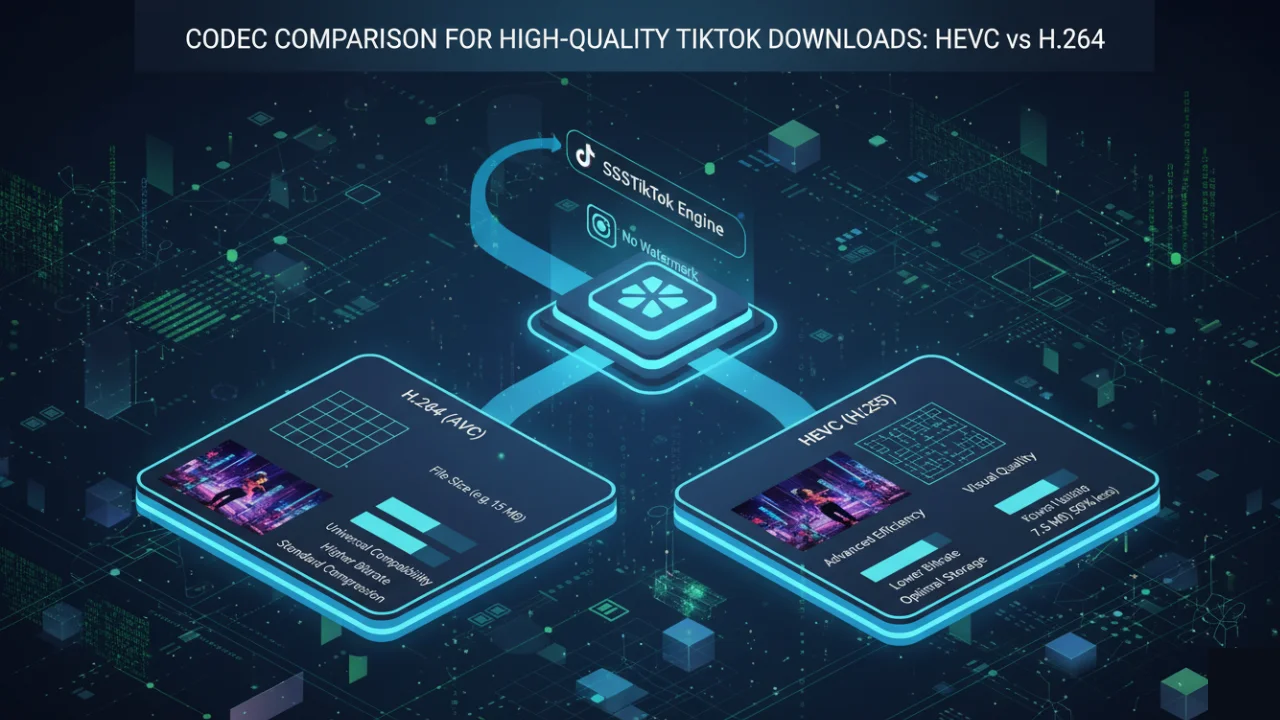
SSSTikTok constitutes an advanced online TikTok downloader platform engineered for watermark removal and facilitating a high-fidelity TikTok video download through specific video compression algorithms. The selection between High Efficiency Video Coding and Advanced Video Coding directly determines the storage efficiency, visual fidelity, and cross-platform compatibility of the extracted HD video resolution.
High Efficiency Video Coding maintains a visual quality attribute at an exceptional retention value while minimizing bandwidth consumption metrics. Bandwidth consumption metrics dictate the overall performance of the extraction algorithm.
Architectural Differences Between H.264 and HEVC for an Online Downloader
The extraction algorithm performance depends upon fundamental architectural differences between Advanced Video Coding and High Efficiency Video Coding formats. Advanced Video Coding establishes a macroblock processing attribute at a maximum sixteen-by-sixteen pixel value. High Efficiency Video Coding replaces standard macroblocks with Coding Tree Units. High Efficiency Video Coding establishes a coding tree unit attribute at a maximum sixty-four-by-sixty-four pixel value.
The larger processing block dimension allows High Efficiency Video Coding to compress visual data more efficiently. If a digital creator inputs a TikTok URL into a video downloader supporting High Efficiency Video Coding, the final output file demands significantly less digital storage compared to Advanced Video Coding protocols.
The superior storage optimization occurs because High Efficiency Video Coding utilizes advanced spatial prediction filters. Advanced spatial prediction filters directly accelerate the TikTok save video procedure by minimizing data transmission payloads.
Comparative Data Metrics: HEVC and H.264 Codec Efficiency
Data transmission payloads correlate directly with specific data compression parameters.
| Compression Codec Specification | Maximum Block Processing Attribute | Storage Reduction Value | Hardware Decoding Prerequisite |
|---|---|---|---|
| Advanced Video Coding (H.264) | 16×16 Pixels | Baseline Standard Retention | Universal Device Compatibility |
| High Efficiency Video Coding (H.265) | 64×64 Pixels | 50% Greater Storage Efficiency | Modern Microprocessor Requirement |
Procedural Workflow to Download TikTok Without Watermark
The modern microprocessor requirement influences the exact procedural workflow executed during the media isolation phase. SSSTikTok executes the media isolation phase utilizing exact sequential network operations. Exact sequential network operations ensure the finalized MP4 download retains maximum source fidelity.
- The client identifies the target media uniform resource locator from the origin application.
- The client inserts the copied media uniform resource locator into the primary input interface of the TikTok downloader.
- The parsing mechanism analyzes the submitted uniform resource locator to extract the high-definition media stream container.
- The processing engine initiates the protocol to download TikTok without watermark utilizing the client-specified compression standard.
- The network server delivers the finalized multimedia file directly to the local storage environment.
Conditional Processing Rules and Media Output Variables
The local storage environment processes incoming files according to strict conditional algorithmic logic. If the client requests an Advanced Video Coding multimedia file, the system prioritizes universal playback compatibility. The universal playback priority happens because legacy playback hardware lacks High Efficiency Video Coding decoding processors.
Conversely, if the client demands maximum visual clarity alongside minimal file size, the system selects High Efficiency Video Coding. The system selects High Efficiency Video Coding because High Efficiency Video Coding executes sophisticated motion vector calculations. Sophisticated motion vector calculations govern the final structural variables of the exported media document.
- Bitrate Allocation Parameter: Controls the digital data volume transmitted per second of media playback.
- Color Subsampling Ratio: Defines the chromatic data compression level embedded within the visual frame array.
- Frame Rate Frequency: Establishes the temporal resolution output of the finalized media compilation.